Future Predictions, Explosive Events for President Biden and the USA
Sep 2, 2021

106K subscribers
https://youtu.be/cmaAkaWMUjA



“Solar flares are intense blooms of radiation that come from the release of the magnetic energy associated with sunspots. The National Oceanic and Atmospheric Administration (NOAA) ranks solar flares using five categories from weakest to stongest: A, B, C, M, and X. Each category is 10 times stronger than the one before it. Within each category, a flare is ranked from 1 to 9, according to strength, although X-class flares can go higher than 9. According to NASA, the most powerful solar flare recorded was an X28 (in 2003).” [Source]Spaceweather reported on May 29th:
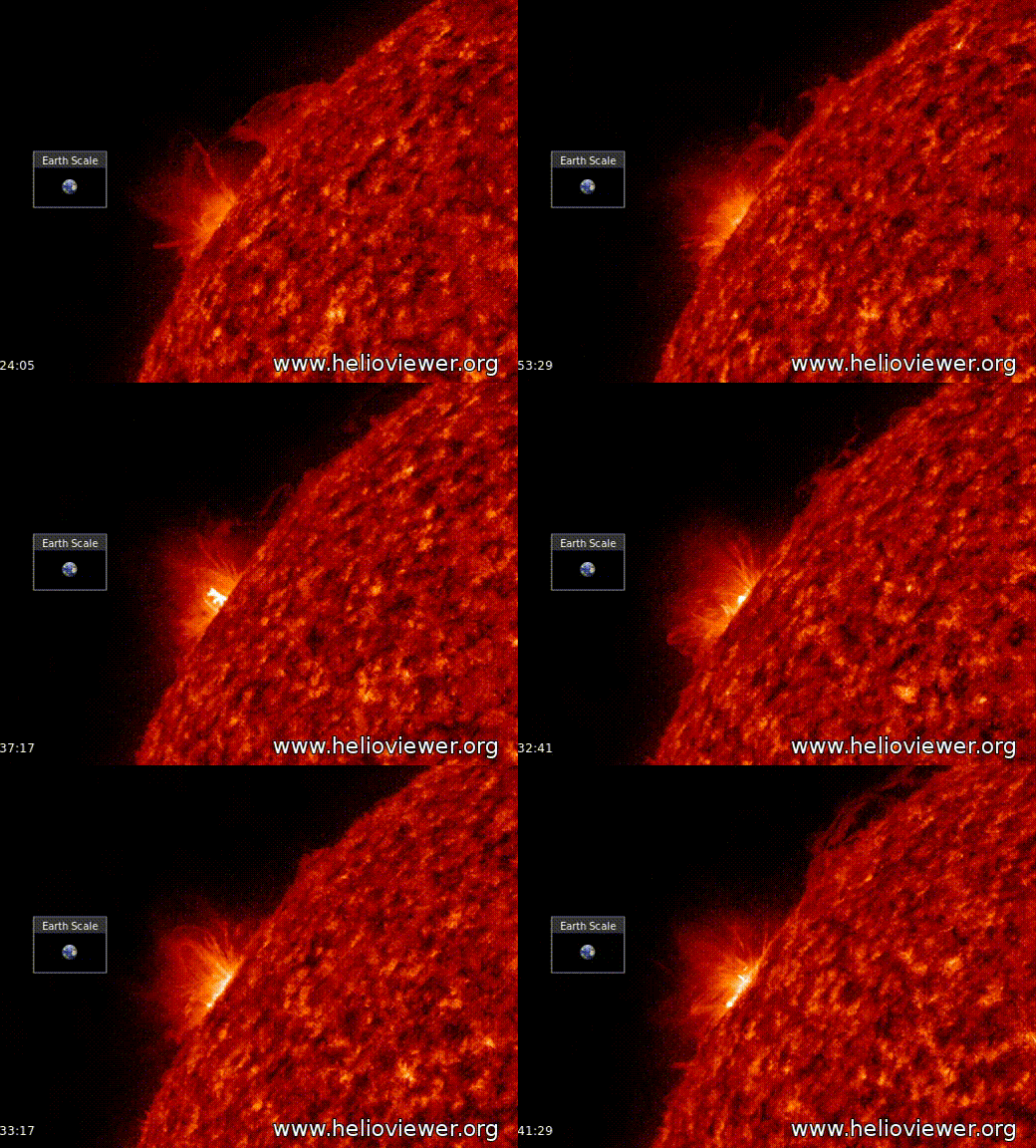
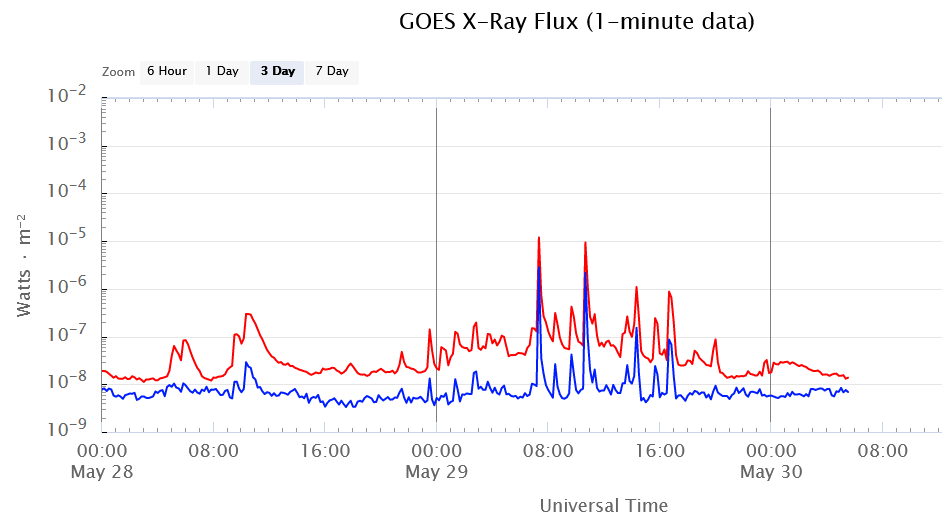
THE SUN IS FLARING AGAIN: Today, the sun produced its strongest solar flare in nearly 3 years. The M-class explosion came from a new-cycle sunspot hidden just behind the sun’s northeastern limb. This weekend, the blast site will turn to face Earth, so future flares, if they continue, could become geoeffective. Visit Spaceweather.com for updates.Following up today, May 30th, Spaceweather reports:
SOLAR MINIMUM, INTERRUPTED: Yesterday, in the pits of the deepest Solar Minimum of the Space Age, the sun unleashed a flurry of solar flares. One of them, an M1-class explosion, was the strongest flare in nearly 3 years. The source of the activity is now turning toward Earth as it rotates into view over the sun’s northeastern limb:Solar activity typically follows cycles of around 11 years, and cycle 24 ended last year. In April of 2019, scientists predicted that the next 11 year cycle, Cycle 25, would begin sometime between mid 2019 and early 2020.
The question now: What is it? Early views of the emerging active region suggest that it is a relatively small sunspot surrounded by a vast field of magnetic froth (plage). The magnetic polarity of the region marks it as a member of new Solar Cycle 25.
“Lisa Upton, a solar physicist with Space Systems Research Corporation and co-chair of the panel issuing predictions, said Cycle 25 should begin between mid-2019 and late 2020 and that it should reach its maximum between 2023 and 2026, when between 95 and 130 sunspots are projected. Average is between 140 and 220 sunspots.” [Source]
“Dates of historical events are compared with moments of solar maxima, beginning from the year 1750. It turns out that violent occurrences in Europe (like revolutions) are correlated with the periods of enhanced solar activity.” [Source]In a document entitled Solar Activity and Human History, Michalec offers the following graph correlating human events and increased solar activity.
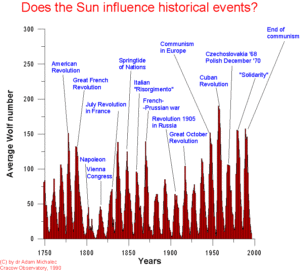
The most famous research was been done by professor A.L. Tchijevsky, a Russian scientist, who presented a paper to the American Meteorological Society at Philadelphia in the late 19th century. He prepared a study of the history of mass human movement compared to the solar cycle, beginning with the division of the Solar cycle into four parts: 1) Minimum sunspot activity; 2) increasing sunspot activity; 3) maximum sunspot activity; 4) Decreasing sunspot activity. He then divided up the agitation of mass human movements into five phases:
1) provoking influence of leaders upon masses
2) the “exciting” effect of emphasized ideas upon the masses
3) the velocity of incitability due to the presence of a single psychic center
4) the extensive areas covered by mass movements
5) Integration and individualization of the masses
By these comparisons he constructed an “Index of Mass Human Excitability” covering each year from 500 B.C. to 1922 A.D. He investigated the histories of 72 countries in that period, noting signs of human unrest such as wars, revolutions, riots, expeditions and migrations, plus the number of humans involved. Tchijevsky found that fully 80% of the most significant events occurred during the years of maximum sunspot activity. He maintained that the “exciting” period may be explained by an acute change in the nervous and psychic character of humanity, which takes place at sunspot maxima.” [Source]
“The nitrogen in our DNA, the calcium in our teeth, the iron in our blood, the carbon in our apple pies were made in the interiors of collapsing stars. We are made of star stuff.” ~Carl Sagan



2,274 Comments