Showing posts with label Medium. Show all posts

Tuesday, February 12, 2019

The Psychology of Belief | Medium

The Psychology of Belief

How your brain distorts the world to support your emotional attachments to certain ideas
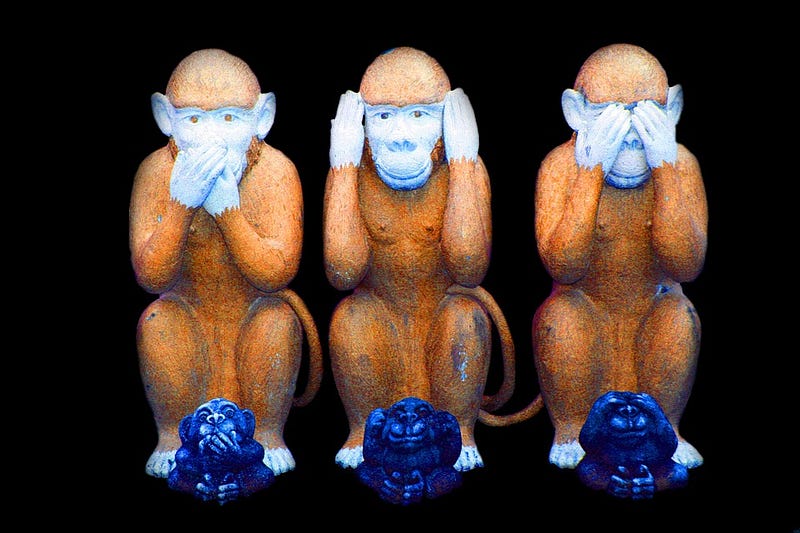
Illustration: Hisham Akira Bharoocha
Listen to this story

Belief is a powerful and necessary thing, governing our societies, our day-to-day and inner lives, our thoughts, hopes, plans, and relationships. You believe that the plane will leave the runway, that working hard will lead to a promotion, that the candidate you support is the best one for the job. Some things you believe because a pattern of experience suggests you should: The sun has come up every morning so far, so why should tomorrow be any different?

But other things you believe even despite logic and evidence to the contrary: The next lottery ticket you buy will be the big one, you can feel it.

Belief is like that; some things you believe because you just do. No one, no matter how brilliant or how educated, is immune to irrational convictions, says Paul Zak, a neuroscientist at Claremont Graduate University. For example, “Linus Pauling was a two-time Nobel Prize winner, one of the most respected scientists ever, and he believed vitamin C was a cure-all for things and spent a lot of years pushing it despite being totally unsupported by medical evidence,” Zak says. “He was as smart as they come, but he deluded himself that this thing was true when it wasn’t.”

That’s because the relationship between belief and fact often goes one way: “Our brains take the facts and fit them to reinforce our beliefs,” Zak says, and those beliefs don’t need to make sense to be deeply held. It’s a relationship that has both benefits and drawbacks — but knowing when it’s helping and when it’s doing us a disservice requires an understanding of how we form emotional attachments to those beliefs.

“To become aware of our biases, we need to understand how our emotions play a role in our decision-making and belief processes,” says Jonas Kaplan, a professor of psychology at USC’s Brain and Creativity Institute. “Most of the time, it’s a good thing. It’s an old, wise, biological system that’s there to help us, but it’s not always relevant to modern life.”

Our earliest beliefs begin to form long before we’re even really cognizant of them. Our brains, Zak explains, are designed to look for patterns, which “allow us to navigate through the world, survive, and reproduce.” Eventually, our dependence on a pattern becomes a belief in its power.

Some of those early beliefs form through observation. For instance, “by about three months old, children understand gravity,” Zak says. “They believe that if you drop a ball, it will hit the ground. So, if you let go and the ball hovers in the air, those infants will look at it like, ‘What the hell?’ The hovering ball violates this tenet they’ve already come to believe.”

Other beliefs are passed along to us from our families and communities, who transmit many of the foundational ideas that shape how we see the world. Evolutionarily speaking, we are herd animals, and there’s an advantage to going along with the crowd. Those group beliefs, in turn, work their way into our most basic concept of who we are. “The systems in the brain that light up when we access our beliefs are the same systems that help us understand stories,” Kaplan says. “We see a lot of the same brain systems involved when people think about who they are and about the beliefs that are most important to them.”

Kaplan describes a neural system known as the default mode network, a set of interconnected areas of the brain associated with identity and self-representation. “It’s the area that lights up in brain imaging when you ask people to lie there and do nothing,” he says. “Of course, they’re not doing nothing. They’re thinking — about themselves and their future and their plans. It also lights up when people read stories with values they consider deeply important to them and when people think about their political beliefs.”

When your most deeply held beliefs are challenged, “many of the most biologically basic brain systems, those responsible for protecting us, kick into high gear.”

In a study published in 2016 in Scientific Reports, Kaplan and his colleagues conducted brain imaging on participants as they read arguments that contradicted their views on issues, both political and nonpolitical, and documented their neurological response to the opposing information. The results of the team’s persuasive efforts were mixed. “We were able to change minds about things like whether Thomas Edison invented the lightbulb and if multivitamins are important,” he says, but other beliefs — those Kaplan calls the “sacred values” — were all but immovable.

The reason those so-called sacred values are so difficult to change, Kaplan says, is that they’re surrounded by a complex network of mental safeguards. When your most deeply held beliefs are challenged, “many of the most biologically basic brain systems, those responsible for protecting us, kick into high gear,” Kaplan says. “These are things like the amygdala, which tells you when to be afraid, and the insula, the part of your brain that processes visceral feelings from the gut and tells you things like if you’re encountering food that’s bad for you. We have a strong motivation to defend those sacred values.”

Of course, not every belief is sacred. So, what determines the strength of our convictions and sets the ones worth protecting apart from the rest? Most of the time, it’s tied to our emotions.

“When you establish your beliefs, if they include emotional tags, the brain saves that information differently so it’s more accessible and impactful,” Zak says. “The strongest beliefs are tied to things like 9/11 or the birth of a child; highly emotional events create beliefs that are almost impossible to change.”

So much of our identity is social, and so many of our social connections are founded on shared beliefs. Ultimately, Kaplan says, most people find it simpler to maintain both their established beliefs and their social circle than to consider a drastic value shift, for reasons that are as practical as they are mental.

“People say, ‘I can’t change my mind. What would my friends think of me?’ People who radically change their political beliefs, for instance, lose a lot: social relationships, jobs, romantic partners,” he says. “There’s a lot at stake when you’re considering changing a belief.”

Our tendency to cling to our beliefs may feel better than the alternative, but that doesn’t mean it’s in our best interest. Our primary self-defense tactic is to remove the threat and avoid anything that might challenge our worldview, which is how so many of us end up living in a feedback loop, surrounded by people who share the same opinions. The effect is only exacerbated by our reliance on social media.

“The world is an information minefield right now,” Kaplan says. We also need to think carefully about which beliefs we allow into that protected inner circle, he adds. “It makes sense to share beliefs and values with people, and it makes sense to defend those beliefs. But to have beliefs that are epistemological — that things are true or false about the world — and be unwilling to hear otherwise could be very dangerous.”

As for all the other little beliefs tucked away in your head, Zak says, you don’t necessarily need to interrogate everything. “Praying the plane lands safely probably doesn’t change anything, but what’s the harm?” he says. “If holding on to the hope that winning the lottery is the solution brings you comfort, why not?”

“If you don’t have some beliefs, you just can’t get through the world,” Zak says. “These rituals and beliefs are really reinforcing, they’re really nice, and there’s something beautiful and distinctly human about them.”

Go to the profile of Kate Morgan
written by

Kate Morgan

Kate is a freelance journalist who’s been published by The Cut, The Washington Post, USA Today, Slate, O Magazine, and others. Read more at bykatemorgan.com.


Tuesday, October 16, 2018

Caitlin Johnstone: Self-Censorship: Where The Real Damage Is Being Done


I was going to write another article today about a different topic, but I backed down because I didn’t think I could deliver the kind of fiery, forceful, unmitigated argument it would need to be without risking getting banned from social media and blogging platforms.

The article I was planning on writing, which you’ll just have to imagine now, would have been titled “ ‘Assange Can Leave Whenever He Wants!’ No, Idiot, He Can’t.” The feature image was going to be a screen shot of a blue-checkmarked empire loyalist named Greg Olear tweeting the infuriatingly dopey argument that Assange is free to just waltz out the embassy doors whenever he wants, so therefore he isn’t actually being imprisoned by an Orwellian power establishment for publishing authentic documents about powerful people. Never mind the fact that you can say exactly the same thing about literally anyone under political asylum; they are all free to leave the political asylum they’ve been granted at any time, and pointing this out is just describing the thing that political asylum is. Never mind the fact that a UN panel ruled that Assange is being arbitrarily detained by the threat of imprisonment. Never mind that the same US government which tortured Chelsea Manning is currently openly pursuing Assange’s arrest because of his publications, making the assertion that he’s “free to leave” the same as saying he’s “free” to jump off a cliff. People don’t want to believe that their government imprisons journalists, so whenever Assange is in the news you see this argument making the rounds.

It would have been a firecracker of an article, but when it came time to write it, I backed down. I’d generally rather scrap an article than write something tepid and boring that won’t make any impact, so the risk of losing access to my platforms outweighed my desire to write what I’d planned on writing.

I’ve been self-censoring more and more lately, especially since the latest round of coordinated cross-platform silencing of multiple alternative media outlets the other day. Back in August I had my Twitter account temporarily deleted when I said the world will be better off without John McCain and a bunch of #Resistance accounts mass reported me; Twitter cited “abusive behavior” as its justification. The only reason my account was restored was because there was a large objection from many high-profile journalists and activists who understand the dangers of internet censorship, and I’m not willing to gamble that I’d get that lucky should something similar happen again. Being able to disrupt establishment narratives on a high-traffic website like Twitter outweighs the benefits of speaking in an unmitigated way.

And that ultimately is precisely the point. If the social engineers can make an example of a few dissident voices in the public eye, everyone else will rein in their own speech and behavior to avoid the same fate. The overall effect of this phenomenon is actually far more effective in suppressing dissident speech than the overt censorship is by itself, because self-censorship actually silences exponentially more anti-establishment opinions. For every one voice you crack down on overtly, a thousand more silence themselves out of self-preservation, not saying things they would otherwise say and not doing things they would otherwise do.

Meanwhile empire loyalists know that they can consistently get away with saying anything they want with total impunity. The other day for example I criticized the fawning media accolades that professional Atlantic Council propagandist Eliot Higgins has been receiving lately, and he responded by calling me “Grotbags”, an obese witch character from a nineties children’s television show. The joke being, you see, that I am overweight, and I am also a woman, so I am therefore similar to the character Grotbags. Ha ha ha. Eliot has been repeating this hilarious joke for months with zero consequences. He also made headlines back in June with his repeated public invitation for people who disagree with him on Twitter to suck his balls, also with zero consequences.

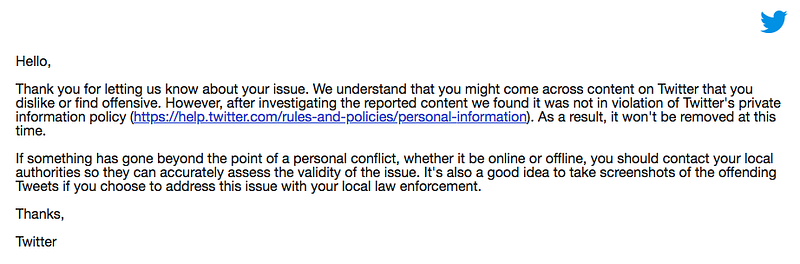
After my August Twitter suspension a #Resistance account publicly doxxed me, posting my home address, phone number and other information. I didn’t make a public ordeal out of it at the time because I obviously didn’t want to draw attention to it, but I did report it because I wanted it deleted. I was not expecting Twitter Support to reject my report, especially after they had me jump through a bunch of hoops to prove that I did in fact live where the doxxer was saying I lived, but they did.
“We understand that you might come across content on Twitter that you dislike or find offensive,” Twitter wrote back. “However, after investigating the reported content we found it was not in violation of Twitter’s private information policy. As a result, it won’t be removed at this time.”


I see this routinely across all platforms; some accounts act without any fear of consequences, others seem primed for hair-trigger suspension.
The bias is distinctly slanted in the favor of those who support CIA/CNN narratives and attack anyone who speaks out of alignment with the agendas of the US-centralized empire.

So while we are mitigating our speech more and more, the Eliot Higginses of the new media environment consistently get away with all manner of abusive behavior without any repercussions. We’re fighting a media war in which we are not just outnumbered and outgunned, but are increasingly forced to fight with one arm tied behind our backs. The only thing we have going for us at this point is that authenticity is attractive and oligarchic funding can’t buy creativity or inspiration.

So anyway, there’s my confession that I have been caving to self-censorship to avoid being de-platformed. Rather than denying it, I think it’s best that we all admit to it when we do it and call it what it is, because it’s an unseen part of the people’s media rebellion that is generally overlooked and under-appreciated. I haven’t really figured out what to do about it beyond that, but in my experience drawing the light of attention to these things is always a good idea.

________________________
Thanks for reading! The best way to get around the internet censors and make sure you see the stuff I publish is to subscribe to the mailing list for my website, which will get you an email notification for everything I publish. My articles are entirely reader-supported, so if you enjoyed this piece please consider sharing it around, liking me on Facebook, following my antics on Twitter, checking out my podcast, throwing some money into my hat on Patreon or Paypal,buying my new book Rogue Nation: Psychonautical Adventures With Caitlin Johnstone, or my previous book Woke: A Field Guide for Utopia Preppers.
Bitcoin donations:1Ac7PCQXoQoLA9Sh8fhAgiU3PHA2EX5Zm2

Friday, January 5, 2018

Differences Between Empath, Intuitive, Psychic, Medium, and Healer by Lynn Zambrano | Om Times

Differences Between Empath, Intuitive, Psychic, Medium, and Healer by

There are many Empath, Intuitive, Psychic, Medium, and Healer practitioners that do more than one of these functions.  Choosing the right practitioner to meet your needs is essential.

What is the Difference in Empath, Intuitive, Psychic, Medium, and Healer?


What are the differences? The definitions have become interchanged and confused. Let us take a moment to review and clarify so that you will connect with the right reader and get the most from your session.


Intuitive:
Intuition is a right brain process that taps into subconscious information in order to provide guidance about everyday life. Being intuitive means that you able to tap into subconscious information in order to receive guidance about your everyday life. Intuition can be used to receive guidance about your own life (personal intuition) or to help other people (professional intuition). People who are intuitive are not necessarily psychic. Being intuitive is about receiving guidance to make better decisions in your life, and helping guide others in theirs.


Psychic:
Being psychic, also know as being clairvoyant, means that you can perceive information that cannot be perceived through the normal senses (also called Extra Sensory Perception – ESP). That can include predicting the future, talking to non-physical beings (dead people, spirits) and being able to sense missing objects or people. Being psychic is about sensing information that other people can’t usually access.


Medium:
A medium is a psychic who has fine-tuned his or her extrasensory perception and can interface with the spirits in other dimensions. They are able to feel and/or hear thoughts, voices or mental impressions from the spirit world. A medium is able to become completely receptive to the higher frequency or energies on which spirit people vibrate.


Empath:
Empath means that you feel other people’s emotions as your own. For example, if someone around you is very angry you might start to feel angry yourself, even though there is no direct reason for you to feel this way. According to Wikipedia, “observing another person’s emotional state activates parts of the neuronal network involved in processing that same state in one, whether it is disgust, touch, or pain”. Empaths have the ability to scan another’s energy for thoughts, feelings and possibly for past, present, and future life occurrences.


Healer:
A healer has the ability to “see” the person as a whole greater than the sum of their parts. The healer’s job is to help remove blocks to an individual’s growth. It is now an accepted fact that humans are electromagnetic beings. All illness results from the lowering of body frequencies below that necessary to maintain homeostasis. By raising the frequencies and aligning the various bodies, all the fields come into coherence. That is health.


Energy Healing has been around forever and is one of the most ancient healing techniques you can use to keep your body in a balanced and healthy state. The ancients were aware of the psychological and physical effects we experience from our own thoughts, from other people, and from invisible forces from “out there.” Alternative energy healing includes these psychological and spiritual realms as well as the physical.

Session Tips:

~ Open mind: Come into the reading with open mind and no expectations
~ Hear the answer, even if it’s not the one answer you want
~ Be Ready to do Your Work, use the information given to work on self
~ Find the Right Reader, example want to talk to deceased persons choose a medium; if you want healing, choose a healer, etc.
~ Readers give guidance, you are responsible for making your own choices
~ The future is Fluid and is always changing, as people’s thoughts and actions affect it. A reader will tell you the most likely outcome if nothing changes.
~ Readers reflect back the information we receive, sometimes we get the information but the interpretation may be askew if it doesn’t seem quite right ask us to clarify
~ If we don’t satisfactorily answer your question or it doesn’t seem complete, ask us to elaborate
~ Mediums cannot make the deceased answer your call, it may not be the right time to connect
~ Readings are meant to EMPOWER you and to help you heal. You are still responsible for your choices.
~ Readers are neutral. We do not give you our opinions, judgments or advise, we simply offer our insights and intuition. Please take the information we give to you, match it with your own intuition and inner knowing and make your own informed decisions.


You will also enjoy 9 Tips to Ensure the BEST Mediumship Demonstration Experience


About the Author

Lynn is an HSP advocate and uses writing to share perceptions on intuition, emotion, energetic frequency and thought forms. Heralding the transformation of HSPs (highly sensitive persons) into HAPs (highly aware persons). Visit her at lynnzambrano.com or contact her at zambranolynn@gmail.com