An exciting new meteor shower – the Camelopardalids – might peak
this Friday night and Saturday morning (night of May 23-24, 2014),
according to clocks in North America. And, although no one can be
absolutely sure, mid-latitudes in North America are predicted to have
the best view of this shower. It’s coming up soon! This possible
shower stems from Comet 209P/LINEAR, discovered in 2004. If the
predictions hold true, Earth might be sandblasted with debris from this
comet, resulting in a fine display of meteors, or
shooting stars
on the evening of May 23, and the morning of May 24. Follow the links
below to learn more about the possible 2014 meteor shower of Comet
209P/LINEAR.
When to watch, and who is best placed on Earth.
What we know about Comet 209P/LINEAR.
Will Comet 209P/LINEAR create a meteor storm?
Click here to find best times to watch the meteor shower in North America, and elsewhere.

Notice
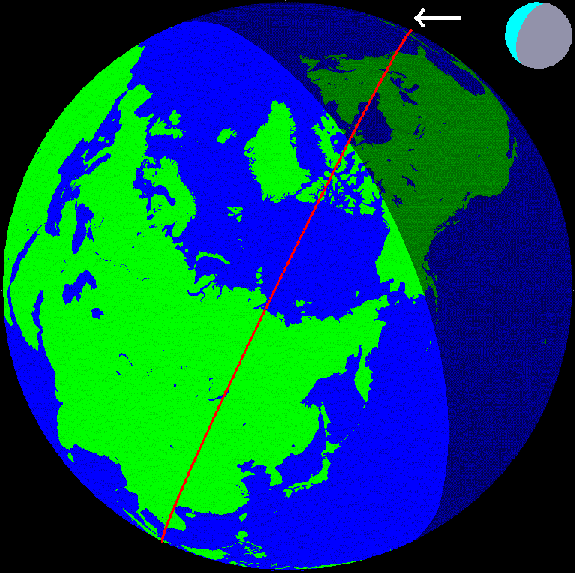
the dark hemisphere of Earth in this illustration. According to
astronomers’ computer models, it’ll be facing into the stream of debris
left behind by Comet LINEAR on the night of May 23-24, 2014. Skywatchers
in southern Canada and the continental U.S. will be especially well
positioned to see the meteors, according to these predictions. Image
via meteor scientist Mikhail Maslov of Russia.
Visit Maslov’s website on the new meteor shower here.

The
constellation Camelopardalis is far to the north on the sky’s dome,
close to the north celestial pole. It’s the radiant point of the
possible meteor shower from Comet 209P/LINEAR.
Chart via Wikimedia Commons.
When to watch, and who is best placed on Earth.
The peak night of the shower is predicted for May 23-24, 2014. Models
suggest that the best viewing hours are between 6 and 8 UTC on May 24.
That is between 2 and 4 a.m. EDT (1-3 a.m. CDT and so on …
translate to your time zone here).
Because of the time predicted for the meteor display, observers in
southern Canada and the continental U.S. are especially well positioned
to see the meteors in the early morning hours of May 24 (or late at
night on May 23). Will the predictions hold true? They are not always
100% reliable, which is why, no matter where you are on Earth, this
shower is worth a try around the night of May 23-24.
The meteors will radiate from the constellation Camelopardalis
(camelopard), a very obscure northern constellation. Its name is
derived from early Rome, where it was thought of as a composite
creature, described as having characteristics of both a camel and a
leopard. Nowadays we call such a creature a giraffe! Since meteor in
annual showers take their names from the constellation from which they
appear to radiate – and since this meteor shower might become an annual
event – people are already calling it the May Camelopardalids.
This constellation –
radiant point of the May 2014 meteor shower
– is in the northern sky, close to the north celestial pole, making
this meteor shower better for the Northern Hemisphere than the Southern
Hemisphere.

The
radiant point of the Camelopardalid meteor shower is in the
far-northern sky, not far from Polaris the North Star. That’s why this
shower is better for the N. Hemisphere.
Chart via skyandtelescope.com

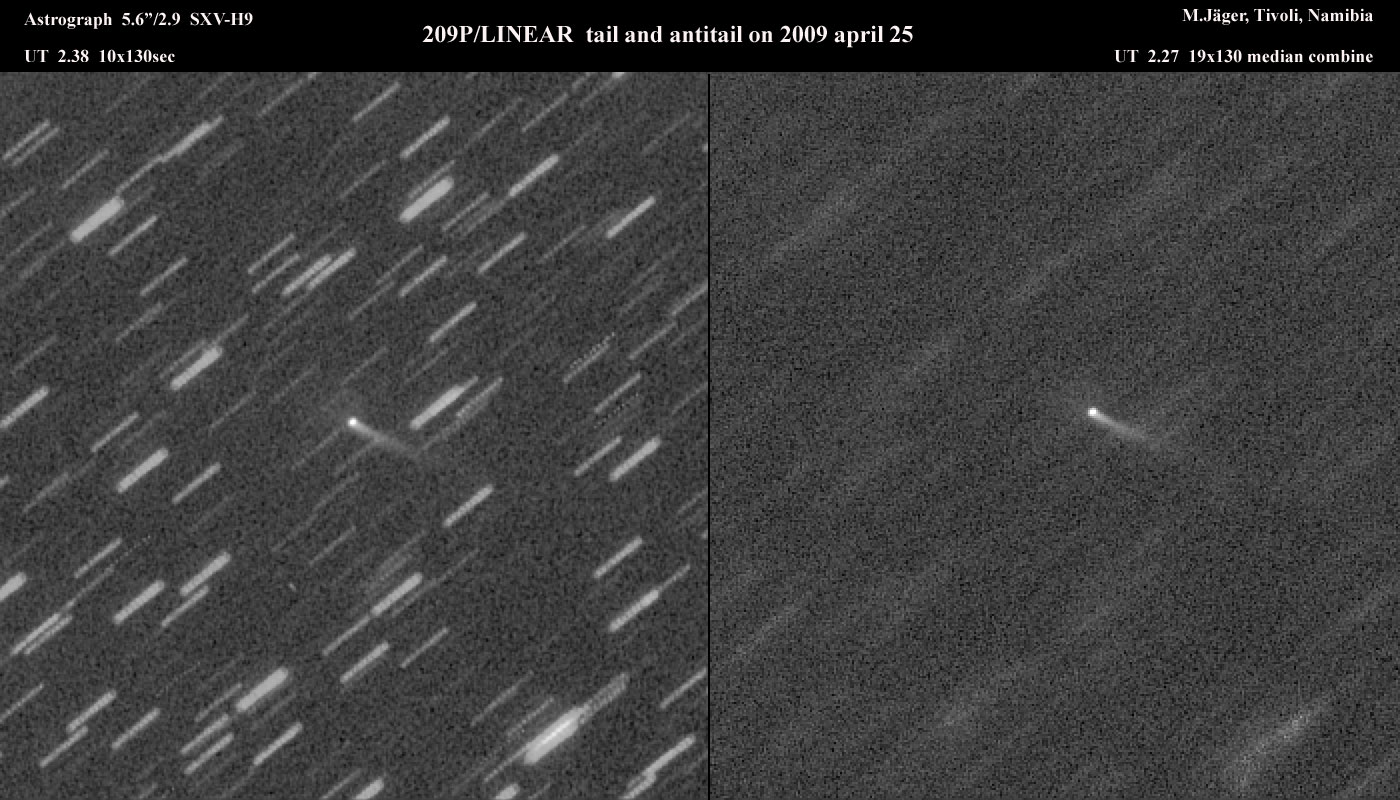
View larger. | Comet 209P/LINEAR on April 25, 2009 as captured by Michael Jager in Austria. Used with permission. Thank you, Michael!
What we know about Comet 209P/LINEAR.
The photo and video above show small and dim Comet 209P/LINEAR. We
won’t see this comet with the eye alone. What’s exciting here is that
calculations of the orbit of 209P/LINEAR indicate that – on the night of
May 23-24, 2014 – Earth will sweep through debris trails from this
comet. Debris left behind by the comet may enter our atmosphere and
burn up, creating a new and perhaps very strong meteor shower!
209P/LINEAR is a periodic comet, that is, its orbit around the sun is
relatively short so that we see the comet come close to the sun again
and again. Comet 209P/LINEAR’s orbit brings it near the sun in just over
5 years. Its last perihelion passage was May 6, 2014. Interestingly,
the debris we’ll encounter is not fresh debris left by the comet during
its 2014 perihelion passage. Instead, we’ll be passing through a stream
of cometary debris left behind by Comet 209P/LINEAR in the 1800s.
This comet was discovered on February 3, 2004 by the automated
observing campaign – the Lincoln Near-Earth Asteroid Research project
(LINEAR) – whose name it bears.
Video above captured by Ido of Baraket (Emerald) Observatory in Israel last night (May 21, 2014).

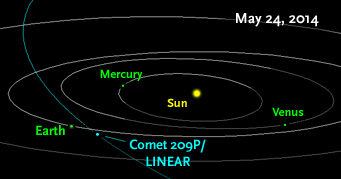
Comet 209P/LINEAR last swept closest to the sun on May 6, 2014. Image by NASA / JPL / Horizons via
skyandtelescope.com
Will Comet 209P/LINEAR create a meteor storm?
In 2012, meteor experts Esko Lyytinen of Finland and Peter Jenniskens
at NASA Ames Research Center were the first to announce that Earth was
due for a May 2014 encounter with debris from Comet 209P/LINEAR. Other
meteor experts quickly confirmed this prediction and some did use the
words “meteor storm.” The most recent calculations, however, indicate
we might get a strong shower, but perhaps not a storm of meteors.
In 2012, Jeremie Vaubaillon of The Institut de Mecanique Celeste et de Calcul des Ephemerides in France
told space.com:
So far,given the observations, we estimate a ZHR
(zenithal hourly rate) of 100/hr to 400/hr, which is an excellent
outburst! But this shower can become an exceptional one. Indeed, given
the current orbit of the comet, all the trails ejected between 1803 and
1924 do fall in the Earth’s path in May 2014! As a consequence, this
shower might as well be a storm.
The more recent, less optimistic calculations come from Quanzhi Ye
and Paul A. Wiegert, both at University of Western Ontario. Their work
was
published online in November 2013. In a report on their work
at skyandtelescope.com,
John Bochanski wrote that Ye and Wiegert’s work suggests a rate of 200
meteors per hour under ideal conditions. Bochanski wrote:
But Ye and Wiegert warn that, given the current
relatively weak dust production of the comet, rates could be much lower.
With the low dust production, as well as the team’s lower estimate of
how many debris streams from the comet’s previous passes are hanging
around in this region of space, it’s highly unlikely that we’re in for a
meteor storm (1,000 per hour) — although the team couldn’t quite rule
it out.
Will Comet 209P/LINEAR produce a meteor storm, or at least a strong
meteor shower? As with all meteor showers, the only way to know is to
go outside on the night of the predicted peak and see for yourself.

209P/LINEAR on May 21, 2014 by Bareket Observatory in Israel.
Bottom line: On the night of May 23-24, 2014 – if predictions hold
true – Earth might be sandblasted with debris from Comet 209P/LINEAR,
resulting in a fine display of meteors, or
shooting stars. The
debris stream was laid down by the comet in the 1800s. People are
already calling this shower the May Camelopardalids, taking its name
from the shower’s radiant point in an obscure far-northern
constellation. Will it be a meteor storm? Most recent calculations say
no, but it might be a strong-enough shower to be thrilling!