Dylan Charles,
Editor Waking Times
With
so many dramatic and consuming events taking place in our world, it’s
easy to forget that as human beings we are deeply affected by all of the
cosmic events taking place in the universe around us. We are
beings of frequency in a universe made of energy.
Major
civil unrest, protesting and rioting began to foment in the United
States on the 28th of May, and on the night of the 29th, the unrest
spread to over 30 American cities, marking the most significant incident
of unrest many of us have ever seen.
While these events are deeply rooted in
societal tension
that has been building for decades, the timing of recent flare ups of
unrest happens to coincide with a new wave of solar activity including
the strongest solar flare we’ve seen in three years.
“Solar flares are intense blooms of radiation that come from the release of the magnetic energy associated with sunspots. The National Oceanic and Atmospheric Administration
(NOAA) ranks solar flares using five categories from weakest to
stongest: A, B, C, M, and X. Each category is 10 times stronger than the
one before it. Within each category, a flare is ranked from 1 to 9,
according to strength, although X-class flares can go higher than 9.
According to NASA, the most powerful solar flare recorded was an X28 (in
2003).” [Source]
Spaceweather reported on May 29th:
THE SUN IS FLARING AGAIN: Today,
the sun produced its strongest solar flare in nearly 3 years. The
M-class explosion came from a new-cycle sunspot hidden just behind the
sun’s northeastern limb. This weekend, the blast site will turn to face
Earth, so future flares, if they continue, could become geoeffective.
Visit Spaceweather.com for updates.
Following up today, May 30th,
Spaceweather reports:
SOLAR MINIMUM, INTERRUPTED: Yesterday, in the pits of the deepest Solar Minimum of the Space Age, the sun unleashed a flurry of solar flares. One of them, an M1-class explosion,
was the strongest flare in nearly 3 years. The source of the activity
is now turning toward Earth as it rotates into view over the sun’s
northeastern limb:
The question now: What is it? Early views
of the emerging active region suggest that it is a relatively small
sunspot surrounded by a vast field of magnetic froth (plage). The
magnetic polarity of the region marks it as a member of new Solar Cycle
25.
Solar activity typically follows cycles of around
11 years, and cycle 24 ended last year. In April of 2019, scientists
predicted that the next 11 year cycle, Cycle 25, would begin sometime
between mid 2019 and early 2020.
“Lisa
Upton, a solar physicist with Space Systems Research Corporation and
co-chair of the panel issuing predictions, said Cycle 25 should begin
between mid-2019 and late 2020 and that it should reach its maximum
between 2023 and 2026, when between 95 and 130 sunspots are projected.
Average is between 140 and 220 sunspots.” [
Source]
As
Minneapolis burns and the violence spreads, it appears that Cycle 25
may be kicking off, and given current events, we could be in for a wild
ride, as many have recognized a historical link between increased solar
activity and major disruptive and revolutionary events for human
societies.
The last
major solar flares occurred in 2017: an M-class on October 20th, and an X-class flare, which is the largest, on September 1oth, 2017.
In August of 2017, the Unite the Right rally took place in Charlottesville, VA, where,
Heather Heyer,
was killed and almost 2 dozen other protestors were injured. Later, on
September 15th, large protests erupted in St.Louis when police officer
when police
Jason Stockley was acquitted of murder in the shooting death of
Anthony Lamar Smith in 2011.
The year 2003 saw
eight of the fifty most powerful solar flares recorded since 1986. This was the same year the Iraq war began, the
6-day Benton Harbor riot in Michigan occurred, and the Miami FTAA protests happened.
Another eight of the fifty most powerful flares since 1986 occurred in 2001, a year that will live in infamy for the events of
9/11, with a large X-class flare and several M-class flares occurring within a week of the destruction of the
Twin Towers.
A massive
X-class flare was recorded in February of 1992, just prior to the devastating Los Angeles riots.
According
to Adam Michalec, there is a long-standing connection between human
activity and solar events, especially unrest and violent revolution.
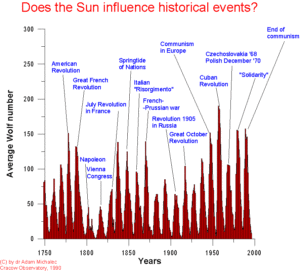
“Dates
of historical events are compared with moments of solar maxima,
beginning from the year 1750. It turns out that violent occurrences in
Europe (like revolutions) are correlated with the periods of enhanced
solar activity.” [Source]
In a document entitled
Solar Activity and Human History, Michalec offers the following graph correlating human events and increased solar activity.
While
the connection to human behavior and major societal events is yet to be
fully understood, interesting research has been done Soviet era
scientist A.L. Tchijevsky, in which he hypothesized that increased solar
activity has an ‘
exciting effect‘ on human beings, affecting our nervous system.
The
most famous research was been done by professor A.L. Tchijevsky, a
Russian scientist, who presented a paper to the American Meteorological
Society at Philadelphia in the late 19th century. He prepared a study of
the history of mass human movement compared to the solar cycle,
beginning with the division of the Solar cycle into four parts: 1)
Minimum sunspot activity; 2) increasing sunspot activity; 3) maximum
sunspot activity; 4) Decreasing sunspot activity. He then divided up the
agitation of mass human movements into five phases:
1) provoking influence of leaders upon masses
2) the “exciting” effect of emphasized ideas upon the masses
3) the velocity of incitability due to the presence of a single psychic center
4) the extensive areas covered by mass movements
5) Integration and individualization of the masses
By these comparisons he constructed an “Index of Mass Human Excitability”
covering each year from 500 B.C. to 1922 A.D. He investigated the
histories of 72 countries in that period, noting signs of human unrest
such as wars, revolutions, riots, expeditions and migrations, plus the
number of humans involved. Tchijevsky found that fully 80% of the most
significant events occurred during the years of maximum sunspot
activity. He maintained that the “exciting” period may be explained by
an acute change in the nervous and psychic character of humanity, which
takes place at sunspot maxima.” [Source]
Final Thoughts
As we all watch and wait to see just how much crazier 2020 can get, it’s easy to lose perspective on the big picture.
In
reality, we are all made of stardust, we’re here for a cosmic blink of
an eye, and when we die our bodies return to being stardust and our
souls move on to something bigger than any of us can possibly grasp.
The events in front of us right now may seem like a huge deal, but there is so much more happening
beyond our perception.
“The
nitrogen in our DNA, the calcium in our teeth, the iron in our blood,
the carbon in our apple pies were made in the interiors of collapsing
stars. We are made of star stuff.” ~Carl Sagan
About the Author
Dylan Charles is the editor of Waking Times and host of Battered Souls: A Podcast About Transformation,
both dedicated to ideas of personal transformation, societal awakening,
and planetary renewal. His personal journey is deeply inspired by
shamanic plant medicines and the arts of Kung Fu, Qi Gong and Yoga.
After seven years of living in Costa Rica, he now lives in the Blue
Ridge Mountains, where he practices Brazilian Jiu Jitsu and enjoys
spending time with family. He has written hundreds of articles, reaching
and inspiring millions of people around the world.
This
article (Strongest Solar Flare in Years Coincides with Riots, Reminding
Us that Solar Activity and Unrest are Historically Linked) was originally created and published by Waking Times and is published here under a Creative Commons license with attribution to Dylan Charles and WakingTimes.com. It may be re-posted freely with proper attribution, author bio, and this copyright statement.





June 2, 2020: Tomorrow, June 3rd, Venus will pass almost directly
between the Earth and the sun. This is having a strange effect on the
planet’s shape. “It is like a ring of fire,” says Didier Favre, who sends
this picture from Brétigny-sur-Orge, France:
When Favre took the picture on June 1st, the sun was only 2 degrees
from Venus–hence the blue sky. “It was not an easy picture to take,”
says Favre, “but what a beautiful view!”
Why does Venus look like a ring? Simple: The planet’s nightside is facing
Earth. Sunlight filtering through the edge of Venus’s carbon dioxide
atmosphere forms a luminous ring around the dark disk.
Astronomers call this an “inferior conjunction of Venus,” and it’s one of the
best in decades. At closest approach on June 3rd, Venus will be only 29
arcminutes (about half a degree) from the center of the solar disk. Only
twice since 1961 has Venus come closer–during the famous Venus Transits
of 2004 and 2012 [ref].
line running through Venus is caused by the planet’s bright light overloading
the pixels of SOHO’s digital camera.
degree away, it is easy for stray sunlight to sneak into optical systems, damaging
sensitive electronics and hurting human eyes. Only skilled observers taking careful
precautions should attempt it.
In space, the Solar and Heliospheric Observatory (SOHO) will be monitoring
the conjunction. Coronagraphs onboard SOHO use opaque disks to block the
glare of the sun, revealing nearby stars and planets. It’s a type of artificial solar eclipse.
Even SOHO will have some trouble, though. On June 3rd, Venus will be so close
to the sun that it briefly dips behind the coronagraph’s opaque disks, hiding the
moment of closest approach. Ground-based observers will have to try to fill in the gap.
Browse the Realtime Venus Photo Gallery for the latest images.
Free: Spaceweather.com Newsletter